A More Visual Conversation About Care
For New Jersey families and adults considering cosmetic or restorative dental care, it can be easier to weigh options when you can see what your dentist is assessing. A visual explanation gives you room to ask questions, share concerns, and understand why a treatment may be recommended. If dental visits make you anxious, asking the team to walk you through the images can make the conversation feel more manageable.
The phrase “3D dental technology” can refer to different tools. Diagnostic imaging shows internal structures such as teeth and jawbone; digital impressions record tooth surfaces for planning restorations; and digital smile design may create a visual proposal for cosmetic changes. A research review describes smile design as a planning and communication aid, not a promise of an exact final result (review of Digital Smile Design). These tools are not interchangeable, and not every practice offers every workflow.
At Belmont Dental Associates, 3-D imaging supports precise diagnostics, while an on-site CAD/CAM system mills permanent ceramic crowns in one visit for eligible cases. These are distinct technologies: imaging helps inform assessment, while CAD/CAM supports crown production. Ask which tool applies to your treatment and what it can show. If cost or discomfort is a concern, Belmont also offers an in-house Belmont Dental Plan for patients without insurance and sedation options.
What a Three-Dimensional Scan Can Show
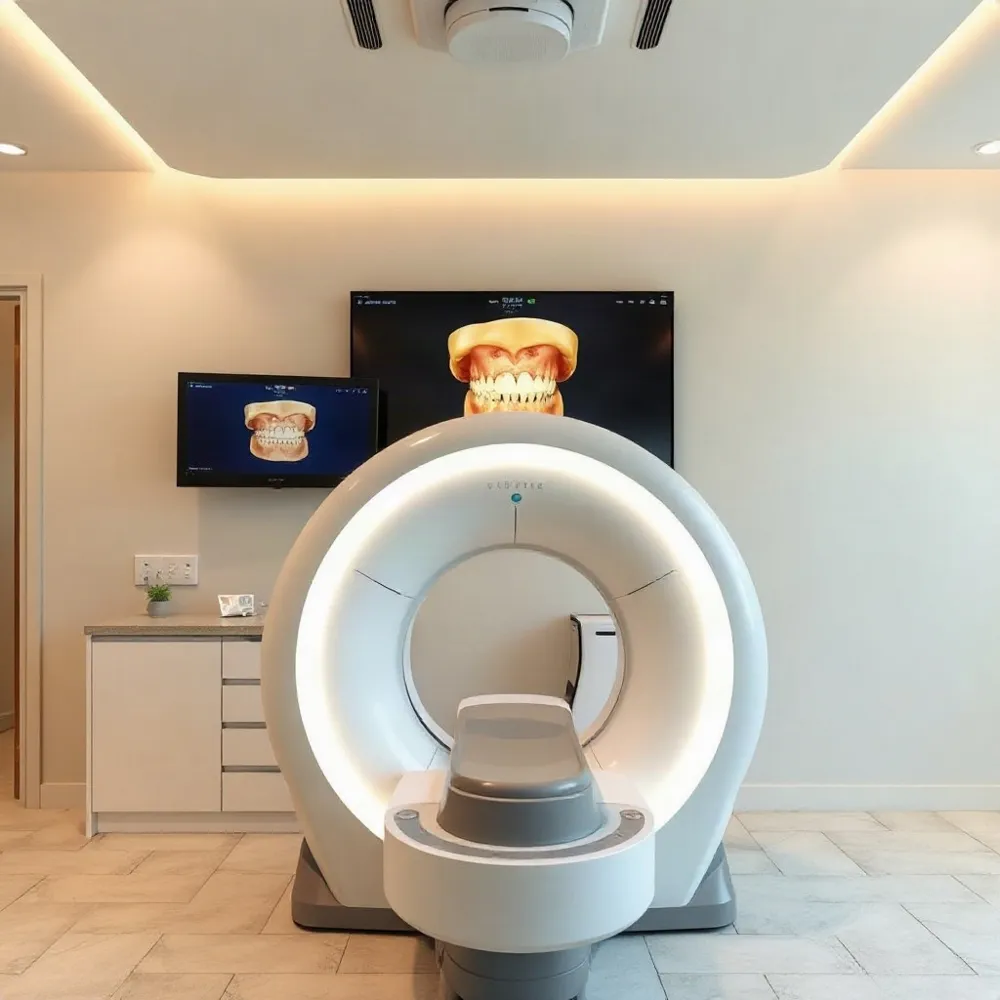
A conventional dental X-ray shows anatomy in two dimensions. Cone beam computed tomography, or CBCT, creates a three-dimensional view that can be examined from different angles. That extra perspective may help a dentist assess details that overlap or are hard to judge in a flat image.
What the scan can show depends on the clinical question. A dentist may use it to examine tooth roots, jawbone, an impacted tooth, or how teeth sit near structures such as nerves and sinuses. For implant planning, the images may provide information about available bone and nearby anatomy. They are one part of the evaluation, alongside your dental history, examination, and treatment goals. A scan does not decide on its own whether an implant or another procedure is right for you. Research reviews describe 3D imaging as a planning and assessment tool, with its value depending on the case and the information needed (review of 3D imaging techniques).
A 3D scan is not required at every appointment. Routine checkups and many common dental concerns may not need one; the dentist recommends imaging when the added detail can help answer a specific clinical question. It is reasonable to ask what the scan is intended to show and how it could affect your care.
Belmont Dental Associates offers 3D imaging to support precise diagnostics. The type of imaging and its purpose depend on your needs and the dentist’s assessment. If you are unsure why a scan has been suggested, ask about its benefits and alternatives before proceeding.
A Smile Preview Is a Planning Tool
Digital smile design is a planning approach that can use photographs and software to show a visual proposal for possible changes before treatment begins. A 2020 review of Digital Smile Design describes how this kind of preview can help patients take part in planning and discuss their expectations with the dentist.
Seeing a proposed look can make it easier to explain what you like, ask questions, and talk through options such as veneers, bonding, or crowns. The design may be adjusted during that conversation to reflect your preferences and the dentist’s clinical advice. A preview can support discussion, but the final result may differ from the proposal.
A cosmetic smile preview is different from a CBCT scan. CBCT images show three-dimensional oral anatomy for clinical assessment, while digital smile design presents a visual proposal for discussing appearance. Having diagnostic 3D imaging does not automatically mean a practice offers a cosmetic preview.
Belmont Dental Associates’ supplied practice information confirms that the office uses 3D imaging for diagnostics, but it does not confirm a digital smile design service or a system for previewing cosmetic results. Ask the team what visual planning is available for your case and how it fits with your oral health and treatment needs. Belmont also offers an in-house plan for patients without insurance, which can help make it easier to discuss costs alongside care options.
Planning a Smile Around Your Needs
A smile makeover is not a fixed package of procedures. It is a personalized plan that may combine cosmetic and restorative care to address how your teeth look, feel, and function. A visual preview can help you discuss possibilities, but your dentist’s examination and your priorities should guide any decision.
You might want to ask about stains, chips, gaps, worn teeth, or misalignment. The right approach depends on the condition of your teeth and gums, your bite, and any underlying concerns. Some issues may need attention before cosmetic treatment is suitable.
Depending on the findings, options could include whitening, veneers, bonding, or clear aligners. Fillings, crowns, bridges, or implants may be considered when teeth need repair or replacement. A review of digital smile design describes how visual planning can help patients and clinicians discuss proposed changes and expectations before treatment begins. A preview is a planning aid, not a promise of an exact final result.
At Belmont Dental Associates, available services include teeth whitening, veneers, orthodontic aligners, and implants. The practice also has an on-site CAD/CAM system for milling permanent ceramic crowns in one visit for eligible cases. These options are not right for everyone, so ask how each might fit your oral health, goals, schedule, and budget.
A useful consultation is a two-way conversation: share what you would like to change, review the clinical findings, and compare suitable approaches before committing. If dental anxiety is a concern, Belmont offers sedation options; patients without insurance can also ask about the in-house Belmont Dental Plan when discussing costs.
Digital Impressions Are Not Diagnostic Scans
What are digital dental impressions, and how do they compare with traditional impressions?
A digital dental impression records the shape and surface of your teeth with a handheld scanner, creating a computer-based model that can help plan restorations such as crowns. A traditional impression uses a tray and setting material. Some people find the tray uncomfortable or have a sensitive gag reflex, but the best method depends on the patient and the treatment.
These impressions are different from a cone beam computed tomography (CBCT) scan. An intraoral scanner captures tooth surfaces; CBCT provides views of internal anatomy, including roots and jawbone. Each answers different clinical questions, so one cannot stand in for the other. Belmont Dental Associates offers 3-D imaging for precise diagnostics, but the supplied practice information does not confirm that it uses an intraoral scanner.
Digital models can feed into computer-based restoration planning and CAD/CAM workflows. A clinical study comparing digital and conventional impressions found differences between methods, but it did not establish that one is always more accurate, nor did it test cosmetic smile previews. The study of intraoral scanning and conventional impressions also notes that both approaches can introduce errors.
Belmont’s on-site CAD/CAM system mills permanent ceramic crowns in one visit. That does not tell us whether a particular crown case uses a digital impression, avoids conventional impressions, or is completed without an outside laboratory. Ask the dental team which steps apply to your treatment.
If impression material makes you anxious or uncomfortable, mention it before the appointment. Ask which methods are available and appropriate for your needs. Belmont also offers sedation options for patients who need extra support feeling comfortable during care.
Discussing Cost Before You Decide
Talking about costs before you decide on a smile makeover? We get it. You want to know what to expect. At Belmont Dental, we believe in clear, upfront pricing so there are no surprises for your family.
Digital smile design is a tool to help you and your dentist plan your new smile. The cost can vary, so it’s always a good idea to ask whether the consultation or preview has a separate fee and whether it is included in your treatment estimate.
Insurance coverage for cosmetic treatments like whitening or veneers can be tricky. Some plans don’t cover procedures that are only for appearance. But if a treatment also helps with a dental function or restores a tooth, your benefits might help. Always check with your insurer and ask our team to help you understand what’s covered. We’re here to make it simple.
Before you say yes to treatment, ask for a written estimate that breaks down the costs. Ask whether same-day technology may be appropriate for your treatment, and what sedation options are available if you feel anxious. Plus, if you don’t have insurance, our in-house Belmont Dental Plan offers an affordable way to get the care your family needs.
Our team in Haledon, Caldwell, and nearby New Jersey communities is ready to help you compare costs and find a plan that works for your family. Give us a call or stop by—we’d love to talk.
Ask What the Scan Will Cost
A 3D dental scan is typically brief, but its price depends on the type of imaging and the clinical question. The exact time also varies with the scan and treatment plan. Belmont Dental Associates offers 3-D imaging for precise diagnostics, but the available information does not specify scan fees or insurance coverage.
Before the appointment, ask the team to explain the expected out-of-pocket cost and check your insurance benefits if you have coverage. Avoid assuming that a general price range found online applies to your scan. You deserve a clear estimate based on the imaging recommended for your care.
A few practical questions can make the conversation easier: What is the scan intended to assess? How will the findings affect the treatment plan? Are there alternatives? What will I owe, and could insurance help cover it? The dental team can explain why the scan is being considered and what information it may provide.
If you do not have dental insurance, ask whether Belmont Dental Associates’ in-house Belmont Dental Plan applies to the proposed care, and whether other payment options are available. Belmont also offers same-day ceramic crowns for eligible cases, which may reduce the need for separate crown appointments, but that service is distinct from the cost of diagnostic imaging. Clarifying both costs before proceeding can help you make a decision that fits your health needs and budget.
Start With Questions and a Conversation
A scan or digital preview can make parts of a treatment plan easier to see, but it cannot replace an examination or promise an exact result. Your dentist should explain how the images relate to your oral health and goals, then discuss what options make sense for you.
Before agreeing to imaging or treatment, ask what the scan is intended to show, whether a preview is available, and what alternatives fit your priorities. It is also reasonable to ask what each step will cost and whether it is included in the proposed treatment.
For families in Haledon, Caldwell, and nearby New Jersey communities, Belmont Dental Associates offers diagnostic 3D imaging and on-site CAD/CAM technology for eligible same-day ceramic crowns. The right approach depends on the patient and procedure, so ask the team to explain what applies to your case.
If dental visits feel stressful, Belmont also offers sedation options. Patients without insurance can ask about the in-house Belmont Dental Plan and review costs before deciding. A clear conversation can help you choose care that fits your health needs, comfort, and budget.