Seeing More Than a Flat Image
A standard dental X-ray gives your dentist a useful flat view of your teeth and nearby bone. But because it compresses three-dimensional anatomy into one image, teeth and other structures can overlap, making depth harder to judge. For many routine checks, that view is enough.
When a clinical question needs more detail, cone-beam computed tomography, or CBCT, can create a three-dimensional view of the teeth, jaw, and surrounding structures. This may help a dentist assess anatomy and plan certain treatments from more than one angle, but it is not necessary for every patient or concern. The FDA recommends dental CBCT only when needed to provide information that other imaging cannot.
At Belmont Dental Associates, 3D imaging can help your dentist assess your needs as part of a broader dental evaluation. Your dentist can explain what a scan may clarify, discuss its benefits and risks, and consider whether a regular X-ray is sufficient. That conversation helps New Jersey families make informed choices without adding imaging that their care does not call for.
How Three-Dimensional Imaging Works
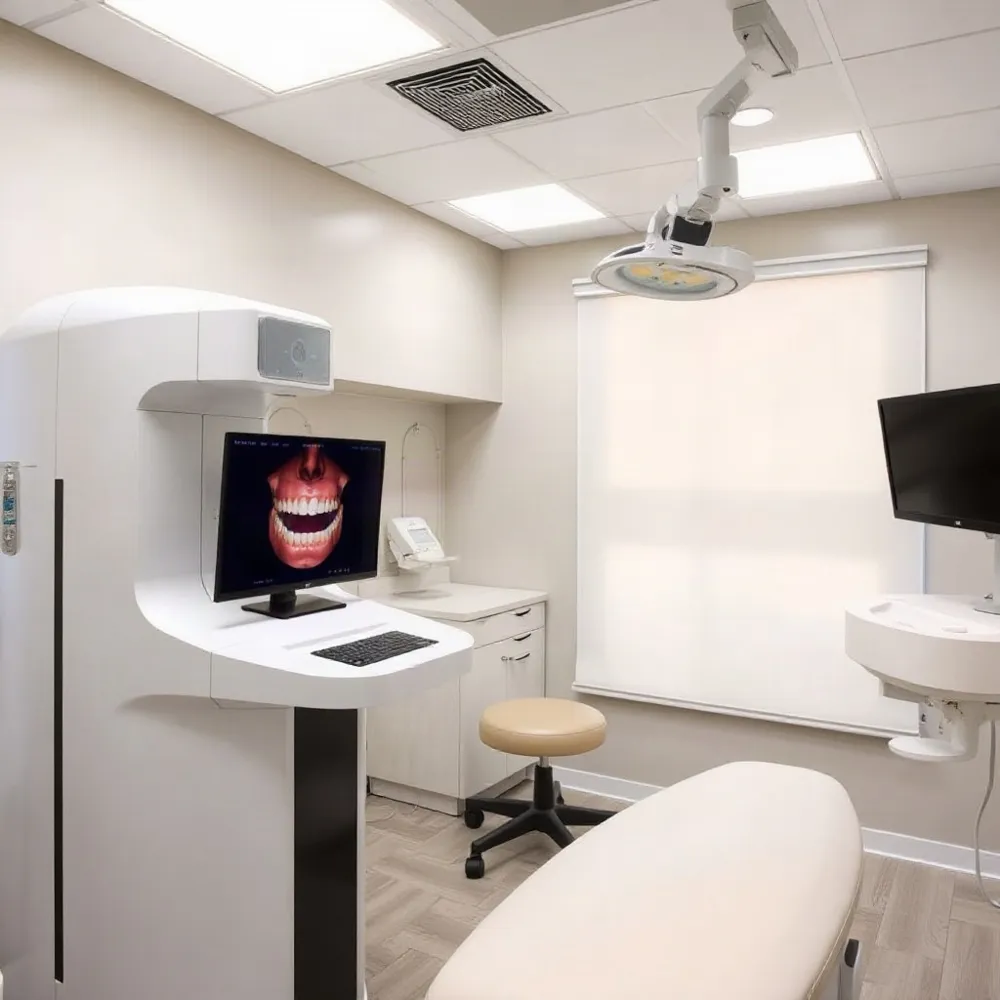
Dental cone-beam computed tomography, or CBCT, uses a cone-shaped X-ray beam and a scanner that rotates around your head. As you sit or stand still, the system captures data from different directions. A computer then reconstructs those images into a three-dimensional view of your teeth and jaw. The FDA explains how dental CBCT creates these images.
Unlike a flat X-ray, the resulting view can be examined from several angles and in cross-sections. This can help a dentist assess how teeth, bone, and nearby structures relate to one another when a clinical question calls for more detail. The scan is an imaging aid, not a diagnosis on its own. Your dentist considers the images alongside an examination, your symptoms, and your treatment needs.
You’ll be asked to remain still while the scanner moves around your head. Image capture often takes less than a minute, although timing varies with the equipment and the area being scanned; RadiologyInfo’s overview of dental CBCT describes how scan time can differ for a full-mouth or regional view. Positioning and discussion of the images may add time to the visit.
At Belmont Dental Associates, 3D imaging supports treatment planning, but it is recommended when the added information is useful, not as a routine step for everyone. The team can explain why a scan is being considered and answer questions before imaging, helping New Jersey families understand what to expect.
When Added Detail Can Guide Care
A three-dimensional scan can help answer questions that a flat image leaves unresolved. By showing teeth and jaw structures from different angles, CBCT may help a dentist locate an impacted tooth, examine its relationship to nearby teeth, or assess the jaw and sinus anatomy. It can also contribute to evaluating certain jaw-joint concerns or investigating pain and suspected pathology. These are possible uses, not a reason to scan every patient. The FDA recommends dental CBCT only when needed to provide clinical information that other imaging cannot.
Implant planning is one example where the additional view may matter. A CBCT scan can show the amount and shape of available bone, along with the position of nearby structures such as nerves. That information helps the clinician consider the patient’s anatomy when planning placement. Belmont Dental Associates offers 3D imaging, which can support careful evaluation when a case calls for more detail.
Three-dimensional images may also assist with orthodontic planning, complex root-canal assessment, and oral surgery. The value depends on the specific concern: a scan may add useful information in a complicated case, while conventional X-rays may be sufficient for routine care. A review of CBCT applications describes uses across dental diagnosis and treatment planning, while noting that images have limitations and need clinical interpretation (review of CBCT in dentistry).
For families in Haledon, Caldwell, and nearby communities, it is reasonable to ask what question a proposed scan is meant to answer and whether the result could affect care. Belmont Dental Associates uses imaging as part of an individual assessment, rather than implying every patient needs a 3D scan.
Choosing Imaging With Care

A 3D dental scan, usually called cone-beam computed tomography (CBCT), uses ionizing radiation. It generally involves more exposure than routine dental X-rays, though less than conventional medical CT. The dose is not the same for every scan: it varies with the equipment, scan area, and settings. The FDA’s guidance on dental CBCT recommends using the scan only when it can provide needed clinical information and reducing exposure while maintaining adequate image quality.
The dose is not the same for every scan, so the dental team should tailor the field of view to the area of concern and use the smallest suitable scan area. At Belmont Dental Associates, 3D imaging supports careful evaluation, but your dentist can explain why it is appropriate for your situation and whether a conventional X-ray may be enough.
If you are pregnant, or have concerns about radiation, tell the dental team before imaging and ask what question the scan is meant to answer. The American College of Radiology and RadiologyInfo guidance on dental CBCT notes that this imaging is selected when regular dental or facial X-rays do not provide enough information.
CBCT also has limits. Movement, image noise, and metal can create artifacts, while soft-tissue detail may be limited. Some findings, including certain cracks, can remain difficult to see. A scan is one part of an assessment, not a diagnosis by itself: a dental professional must interpret the images alongside an exam and other relevant information.
Matching the Scan to the Need
Does every dental patient need a 3D scan? No. For routine checkups, cavity checks, and many straightforward concerns, conventional dental X-rays often provide enough information. For routine checkups, cavity checks, and many straightforward concerns, conventional dental X-rays often provide enough information.
A dentist may consider CBCT when a specific question calls for a more detailed view, such as planning an implant, locating an impacted tooth, or assessing complex root canal anatomy. The scan can show relevant structures from multiple angles, but it is not the right tool for every concern. RadiologyInfo’s overview of dental CBCT can help you understand when this imaging is appropriate.
Understanding Fees and Coverage

How much does a 3D dental scan cost, and might insurance cover it? A dental office’s published cost estimate for a CBCT scan is about $150 to $600, but the fee can vary with the size of the area being scanned, your location, and the dental office. Ask for the price before scheduling so you can plan for any out-of-pocket expense.
Dental insurance may cover some or all of the cost when a scan is needed for diagnosis or treatment, but benefits depend on your plan and the reason for imaging. Ask the office about the fee and whether staff can check your benefits, then confirm coverage directly with your insurer. The FDA’s guidance on dental CBCT also emphasizes that these scans should be used when they are medically appropriate, which is a good reminder that the decision to scan should be based on your dental needs, not on upselling.
A Conversation Before Any Scan
A 3D scan can add useful detail when a dental question calls for it, but it is not needed for every patient or appointment. The FDA’s guidance on dental CBCT advises using it only when that information cannot be obtained through other imaging.
If your dentist recommends a scan, ask what it will help clarify, whether a conventional X-ray could answer the question, and what the fee may be. For children or anyone feeling anxious, it is also reasonable to ask about the steps involved and ways to feel more comfortable.
At Belmont Dental Associates, 3D imaging supports precise diagnostics, while the team can explain the reason for an exam and discuss care options. Families in Haledon, Caldwell, and nearby communities deserve clear answers before making decisions about treatment.